


 0
0
 0
0
Securing funding for your small business shouldn’t feel like navigating a maze blindfolded. Yet thousands of Canadian entrepreneurs face exactly that challenge every year, often accepting the first loan offer they receive or giving up equity they didn’t need to surrender. An independent small business funding advisor changes this equation entirely.
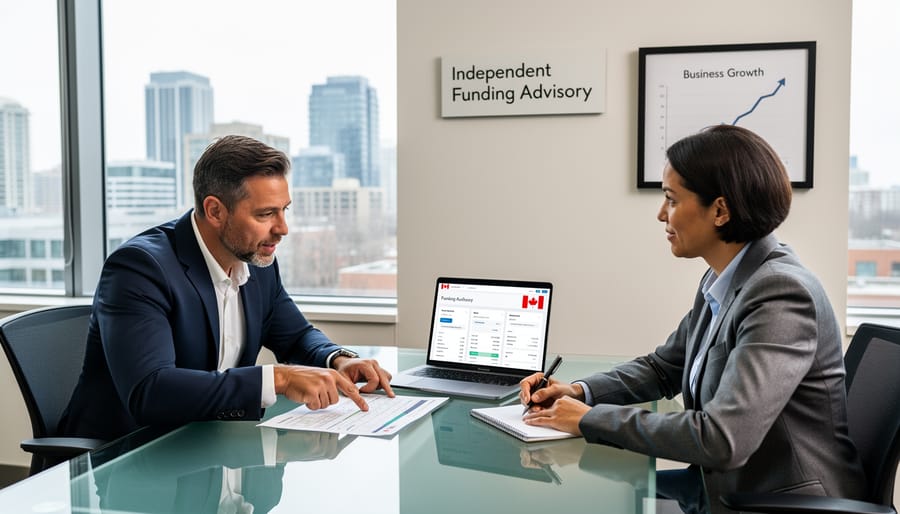
Unlike bank representatives who only present their institution’s products, independent advisors work solely for you. They assess your unique business situation, identify funding options across multiple sources, and negotiate terms that align with your growth goals rather than a lender’s sales targets. The difference matters. Consider the Calgary-based specialty foods company that nearly accepted a 12% business loan from their bank before an independent advisor structured a combination of a government-backed loan at 6% and a strategic investor, saving them $47,000 in interest over three years while preserving ownership control.
The value extends beyond finding better rates. Independent advisors translate complex funding landscapes into clear choices, helping you understand whether traditional term loans, lines of credit, government grants, angel investors, or revenue-based financing fits your specific needs. They prepare compelling applications that address lender concerns before they arise and coach you through presentations to investors or financial institutions.
Finding the right advisor requires some homework. An independent financial advisor in Edmonton or your region should hold relevant credentials, demonstrate experience with businesses similar to yours, and operate on transparent fee structures. The investment typically pays for itself many times over through better terms, faster approvals, and funding solutions you wouldn’t have discovered alone.
What Makes a Funding Advisor ‘Independent’?
An independent small business funding advisor works exclusively for you, not for banks, government programs, or lending institutions. This distinction matters more than you might think. While a bank representative helps you access their products and a government program officer guides you through their specific grants, an independent advisor’s sole responsibility is finding the best funding solution for your business, regardless of the source.
- Independent Advisor
- A funding professional who represents business owners and evaluates options across multiple lenders, government programs, and funding sources without obligation to any particular institution.
- Captive Advisor
- A representative employed by a specific bank, credit union, or lending institution who can only recommend their employer’s products and services.
- Fiduciary Duty
- A legal and ethical obligation to act in the client’s best interest, putting their needs ahead of all other considerations including the advisor’s own compensation.
- Fee-Based Model
- Compensation structure where the advisor charges the client directly for services, typically a flat fee or percentage, creating transparency in how they’re paid.
- Commission-Based Model
- Payment structure where the advisor receives compensation from lenders or funding sources when a deal closes, which can create potential conflicts of interest.
True independence shows up in how your advisor gets paid. Some independent advisors work on a fee-only basis, charging you directly for their time and expertise. Others earn commissions from multiple funding sources when they successfully place your application. The key difference is choice. An independent advisor with access to dozens of lenders can recommend the one that truly fits your needs, while a captive advisor has one option to offer you.
Consider Sarah, who runs a manufacturing business in Mississauga. She met with her bank first, where the representative offered a single loan product with a 9% interest rate. An independent advisor she consulted later found her a combination of an EDC loan at 5.5% and a provincial grant that covered 30% of her equipment costs. The advisor had no incentive to send her to that particular combination except that it saved her business nearly $40,000 over three years.
Independence also means your advisor stays current across the entire funding landscape. They track changes to government programs, new alternative lenders entering the market, and shifts in qualification criteria across institutions.

The Hidden Costs of Going It Alone
Time Wasted on Wrong-Fit Funding
Without clear guidance, many business owners chase funding that’s completely wrong for them. You might spend three months preparing an application for the Canada Small Business Financing Program only to discover your business doesn’t meet the eligibility requirements. Or you could invest weeks gathering documents for a grant program designed for exporting manufacturers when you’re running a local service business.
This happens more often than you’d think. A Toronto retailer spent four months applying for innovation grants meant for tech startups. A Vancouver contractor prepared extensive paperwork for expansion funding while still operating at a loss, automatically disqualifying them from most commercial programs.
The cost goes beyond time. There’s the opportunity cost of missing deadlines for programs you actually qualify for, the frustration that drains your energy, and the financial strain of delays in getting capital you need now.
An independent advisor helps you build a realistic funding checklist matched to your business stage and needs. They immediately identify which programs fit your situation and which ones you should skip entirely, saving you months of wasted effort.
Money Left Behind
Canadian small business owners leave thousands of dollars on the table every year simply because they don’t know what’s available to them. The numbers tell a sobering story.
The average small business in Canada misses out on $15,000 to $40,000 annually in unclaimed government grants and tax credits, according to industry estimates. The Scientific Research and Experimental Development (SR&ED) tax credit alone goes underutilized by nearly 60% of eligible businesses. Why? Most entrepreneurs don’t realize their product development work qualifies, or they find the application process too daunting to tackle alone.
Provincial programs add another layer of missed opportunity. Ontario’s Digital Main Street program offers grants up to $7,500 for digital transformation. Quebec’s various innovation credits can cover up to 30% of eligible expenses. Yet awareness remains low outside of those who work in the funding space daily.
Beyond grants, there’s the cost of accepting suboptimal loan terms. A Toronto bakery owner recently shared how she almost signed a merchant cash advance at 45% effective interest before an advisor showed her a qualified alternative at 9.8%. That decision saved her business over $28,000 in the first year alone.
These common startup mistakes aren’t due to laziness. You’re busy running your business. The funding landscape changes constantly, with new programs launching quarterly and eligibility criteria shifting. Keeping up requires dedicated attention that most entrepreneurs simply don’t have while managing daily operations.
An independent advisor’s job is knowing where that money hides and how to help you claim it.
Bank Reps vs. Independent Advisors: Understanding the Difference
When you walk into your bank to discuss a business loan, the person across the desk seems helpful and knowledgeable. And they often are. But there’s something you need to understand: they work for the bank, not for you.
Bank representatives have sales targets. They’re evaluated on how many products they move and how much revenue they generate for their employer. If you qualify for their business loan, that’s what they’ll offer you. They won’t suggest you check out a credit union down the street offering better rates, and they certainly won’t recommend a government grant program that would give you non-repayable funding instead.
The same limitation applies to government program officers. While they’re not chasing sales commissions, they can only present the specific programs their department administers. A Business Development Bank of Canada officer will tell you about BDC loans. A regional development agency representative will focus on their grants and subsidies. Nobody sees your complete picture.
Here’s how the different types of advisors compare:
| Advisor Type | Who They Represent | Funding Options Presented | Cost to You | Best For |
|---|---|---|---|---|
| Bank Representative | Their financial institution | Only their bank’s products | Free consultation, interest on loans | Simple loans when you already bank there |
| Government Officer | Their specific program/agency | Programs they administer | Free consultation | Accessing one known government program |
| Independent Advisor | You, the business owner | All available options across lenders and programs | Consulting fee or success-based | Complex needs, multiple funding sources, maximizing options |
Think of it this way. If you needed legal advice, would you ask a lawyer who only practiced one type of law and worked for the opposing party? That’s essentially what happens when you rely solely on institutional representatives for funding guidance.
Independent advisors get paid by you, which means their job is finding the best funding mix for your situation. They’ll compare conventional bank loans against alternative lenders. They’ll identify government grants you didn’t know existed. They’ll structure your financing to minimize costs and preserve equity.
Consider Maria, who runs a manufacturing business in Mississauga. Her bank offered a $150,000 loan at 7.2% interest. An independent advisor identified a combination solution: a $75,000 government grant, a $50,000 BDC loan at 5.8%, and only $25,000 from her original bank. She saved thousands annually in interest and didn’t have to repay half the funding at all.
That’s the difference independence makes. No hidden agenda, no quotas to meet, just objective advice focused on your success.
Five Ways Independent Advisors Create Value for Canadian Startups

Unbiased Funding Strategy Tailored to Your Business
An independent advisor starts by getting to know your business inside and out. They’ll review your cash flow, growth plans, credit history, and industry challenges. Then they compare options across the entire Canadian funding landscape.
Think about it this way: a bank representative can only offer their institution’s products. If you need $75,000 and the bank’s minimum business loan is $100,000, you’re stuck. An independent advisor might suggest combining a $50,000 term loan from a credit union with a $25,000 government grant program you didn’t know existed.
Sarah Chen, who runs a Toronto catering company, experienced this firsthand. Her advisor recommended splitting her $120,000 expansion between a BDC loan (lower interest for equipment), a regional development grant (covering 30% of renovation costs), and a small line of credit for inventory fluctuations. “I would have just taken whatever my bank offered,” Sarah says. “This mix saved me thousands in interest and gave me more flexibility.”
Your advisor creates a customized funding roadmap that matches your timeline, risk tolerance, and repayment capacity. They’re working for you, not any lender, which means the strategy fits your actual needs.
Access to the Full Canadian Funding Landscape
Canada’s funding ecosystem is surprisingly complex. There are hundreds of programs spread across federal departments, provincial ministries, regional development agencies, municipal offices, and private foundations. Most entrepreneurs know about basic bank loans, maybe a government grant or two. That’s where their search ends.
Independent advisors spend their careers mapping this landscape. They track which programs accept applications year-round versus seasonal deadlines. They know the Regional Relief and Recovery Fund differs from the Canada Small Business Financing Program in eligibility and structure. They understand that Saskatchewan offers different manufacturing incentives than Ontario, and that Vancouver’s municipal grants won’t match what Montreal provides.
This knowledge proves especially valuable for those starting without capital. A Toronto advisor recently helped a client stack three funding sources: a federal innovation grant, provincial wage subsidy, and a local tourism development loan. The business owner had only applied for one before getting professional help. The advisor identified two additional programs the entrepreneur qualified for but never knew existed, securing an extra $47,000 in non-repayable funding.
Application Expertise That Gets Results
A well-prepared application is your business’s best first impression, and independent advisors know exactly what funders want to see. They help you highlight revenue trends, explain seasonal fluctuations, and present financial projections that make sense to lenders rather than raising red flags. This expertise matters because small errors can derail your application before you even get a meeting.
Take Sarah from Kelowna, who applied for equipment financing on her own and got rejected twice. Her advisor spotted the issue: she’d listed personal expenses mixed with business costs, making her cashflow appear unstable. After reorganizing her financials and adding a clear narrative explaining her growth strategy, she secured approval within three weeks.
Advisors also help you dodge common rejection triggers. Missing documentation, unrealistic projections, and unclear use of funds top the list of why applications fail. Your advisor ensures every document tells a consistent story about your business’s stability and growth potential.
They’ll coach you on presenting your business compellingly, translating your day-to-day operations into language that resonates with risk-averse lenders. That preparation often means the difference between “maybe later” and “approved.”
Negotiation Power You Don’t Have Alone
When you approach lenders directly, you’re working with their standard offers. An independent small business funding advisor brings something different to the table: negotiating leverage you simply don’t have on your own.
These advisors know the current funding landscape inside and out. They understand what lenders are offering across the market, which institutions have flexibility on rates, and where there’s room to negotiate better terms. That knowledge translates into real savings for your business.
Consider Maria, a Toronto retailer who initially received a loan offer at 8.5% interest. Her funding advisor, armed with competing offers and market data, negotiated that rate down to 6.9%. On a $150,000 loan, that difference saved her over $10,000 in interest costs.
Beyond interest rates, advisors can negotiate more favorable repayment schedules that match your actual cash flow patterns. They know which lenders offer grace periods, seasonal payment flexibility, or penalty-free early repayment options. They’ve built relationships with decision-makers who can approve terms outside standard parameters.
You’re essentially hiring someone who speaks the lender’s language and knows exactly what concessions are possible. This expertise typically pays for itself many times over through the improved terms they secure.
Ongoing Support Through Growth Stages
Your funding needs shift dramatically as your business matures. What works during the startup phase rarely matches what you’ll need during expansion or scaling. An independent advisor adapts their guidance to match each growth stage.
During the startup phase, advisors typically focus on bootstrapping strategies, government grants, and small seed funding options. They help you access startup resources and build your initial financial foundation without overextending.
As you enter the growth phase, the conversation changes. Your advisor might introduce working capital solutions, equipment financing, or larger credit facilities. They’ll assess your revenue patterns and recommend timing strategies for bigger funding asks.
When you’re ready to expand, they shift focus again to term loans, investor relationships, or even preparing for venture capital discussions. This staged approach prevents you from pursuing funding options before you’re ready or missing opportunities because you waited too long.
The real value? You don’t need to become a funding expert yourself. Your advisor brings the knowledge you need exactly when you need it, adjusting their recommendations as your business circumstances evolve.
Real Canadian Success Stories
Maria Chen launched her specialty coffee roasting business in Burnaby, British Columbia, with big dreams but limited banking options. After two major banks declined her loan application, she felt stuck. A friend recommended she speak with an independent funding advisor who specialized in food and beverage startups. Within three weeks, her advisor had identified a combination of funding sources Maria didn’t know existed: a $40,000 Community Futures loan at preferential rates, a $15,000 provincial small business grant, and a $25,000 credit union term loan structured specifically for equipment purchases. The total package of $80,000 gave her everything she needed to get started, compared to the single $35,000 bank loan she’d been denied.
“I was ready to give up after those rejections. My advisor didn’t just find me more money, she found me the right money for each part of my business plan.”
The advisor’s fee was $2,500, but Maria says the grant alone covered that cost, and the lower interest rate on the Community Futures loan saved her nearly $4,000 over the loan term.
Across the country in Moncton, New Brunswick, Jacques Leblanc needed $120,000 to expand his construction company and purchase two additional vehicles. His bank offered him $60,000 at a higher rate than he’d hoped for. An independent advisor reviewed his financials and discovered Jacques qualified for the Canada Small Business Financing Program, which his bank hadn’t mentioned. The advisor also found an Atlantic Canada Opportunities Agency grant worth $18,000 and negotiated better terms with a different lender. Jacques secured $130,000 in total financing, more than his original target, with monthly payments that were actually lower than the bank’s initial offer. His business added four new employees within six months.
These stories show how independent expertise opens doors that many business owners don’t even know exist.
When You Actually Need an Independent Advisor
Not every funding journey requires professional help. Sometimes you can figure it out yourself. But certain situations call for an independent advisor’s expertise, and recognizing these moments can save you significant time, money, and headaches.
Consider bringing in an advisor when you’re pursuing complex funding structures. If you’re combining multiple sources like government grants, equity investment, and traditional loans, an advisor helps you sequence everything properly and avoid conflicts. They know which programs don’t play well together and which combinations create leverage.
Companies facing rapid growth or major transitions benefit enormously from independent guidance. Scaling from $500,000 to $2 million in revenue requires different funding strategies than launching your first location. An advisor who has guided other businesses through similar growth stages brings perspective you simply can’t get from your bank manager.
You’ll also want professional help if you’ve been declined for financing and don’t understand why. Sometimes the issue is timing, sometimes it’s presentation, sometimes it’s choosing the wrong program entirely. An advisor can diagnose the real problem and chart a better path forward rather than having you submit application after application with the same weaknesses.
Similar to business coaching independent funding advice pays off when you’re entering unfamiliar territory. First-time equipment financing, exploring venture capital, or applying for research grants all have unique requirements and pitfalls.
On the flip side, you probably don’t need an advisor for straightforward situations. Renewing an existing credit facility you understand? A small business credit card? Basic overdraft protection? These are manageable on your own with some research.
The real question isn’t whether you could potentially manage without help. You probably could. The question is whether your time and expertise are better spent elsewhere while someone with specialized knowledge handles your funding strategy efficiently.

How to Find and Vet an Independent Funding Advisor in Canada
Finding the right independent funding advisor starts with knowing where to look. Begin your search through professional networks like the Canadian Association of Business Advisors or local chambers of commerce, which often maintain directories of certified professionals. Ask fellow entrepreneurs in your community for referrals. Someone who helped a similar business secure funding successfully is worth investigating. Online searches combined with LinkedIn profiles can reveal advisors specializing in your industry or region.
Once you’ve identified potential advisors, the vetting process requires careful attention:
- Request an initial consultation to discuss your funding needs and gauge their understanding of your business model.
- Ask for client references and follow up with at least two previous clients about their experience and results.
- Verify their credentials, including any certifications, professional memberships, and years of experience in Canadian small business funding.
- Review their track record by asking what percentage of clients they’ve successfully placed with funding and average amounts secured.
- Request a detailed proposal outlining services, timelines, and all associated costs before committing.
During these conversations, ask pointed questions. How many funding sources do they regularly work with? Can they explain the difference between various government programs relevant to your situation? What happens if you don’t secure funding after working together? Their answers will reveal depth of knowledge and commitment to your success.
Watch for red flags that signal you should keep looking. Advisors who guarantee funding approval are being unrealistic about the process. Those who push a single funding source without exploring alternatives may have undisclosed partnerships. Be cautious if they request large upfront payments before delivering any value or refuse to provide references from past clients.
Pricing structures vary considerably. Some advisors charge hourly rates between $100 and $250, while others work on project fees ranging from $2,000 to $10,000 depending on complexity. Success-based fees, typically 2-5% of funds secured, align the advisor’s interests with yours but can become expensive on larger amounts. Transparent pricing discussed upfront prevents surprises later.
Expect a professional advisor to invest time understanding your business before recommending solutions. They should explain options clearly, prepare polished application materials, and maintain regular communication throughout the process. The relationship works best when both parties commit to open dialogue and realistic timelines. Remember, you’re hiring expertise that could secure tens or hundreds of thousands in capital, so thorough vetting pays dividends.
Making Independent Advice Work Within Your Budget
Cost shouldn’t be a barrier to getting the funding advice you need. Let’s break down what working with an independent advisor actually costs and how to make it work for your budget.
Most independent funding advisors in Canada use one of three fee structures. Hourly rates typically range from $100 to $300, depending on experience and location. Some offer project-based pricing for specific needs like application reviews or funding strategy development, usually between $500 and $3,000. A few work on retainer arrangements for ongoing support, which can provide better value if you need regular guidance.
Here’s the good news: you don’t need to commit to expensive packages right away. Many advisors offer initial consultations at reduced rates or even free. Use this opportunity to assess fit and get preliminary direction. Sometimes a single focused session can save you months of trial and error.
Consider the return on your investment. If an advisor helps you secure a $50,000 loan you wouldn’t have found on your own, or prevents a costly mistake in your application, their fee pays for itself quickly. Toronto-based Maya Chen spent $800 on funding advisory for her catering business and secured $40,000 in combined grants and financing within three months.
Bootstrap entrepreneurs have options too. Some advisors offer sliding scale fees based on your business stage. Community futures organizations across Canada provide free or low-cost advisory services. Small business development centers often include funding guidance in their programs at no charge.
You can also start with self-directed research and bring specific questions to an advisor for targeted help. This hybrid approach keeps costs down while giving you expert input where it matters most. Think of it as strategic spending rather than an all-or-nothing decision.
Competing for business funding shouldn’t feel like a David versus Goliath battle, but for many Canadian small business owners, that’s exactly what it becomes. Independent funding advisors level that playing field. They give you the same strategic advantages that larger companies use: insider knowledge of what lenders actually want, polished proposals that stand out, and connections to funding sources you’d never find on your own.
Think of hiring an independent advisor not as another business expense, but as an investment in your company’s future. The right advisor can help you secure significantly more capital than you could alone, often at better terms. They save you months of research and rejected applications. More importantly, they free you to focus on what you do best: running your business.
Take Sarah Chen, who runs a sustainable packaging company in Vancouver. She spent six months trying to navigate funding options herself before hiring an advisor. Within five weeks of working together, she secured a combination of a government grant and private financing that gave her startup the runway it needed. “I wish I’d hired someone from day one,” she said. “The time and stress I would have saved was worth far more than the fee.”
Your next step is straightforward. Research advisors who specialize in your industry or funding needs. Schedule consultations with two or three to find the right fit. Ask about their track record, fee structure, and approach. Then make your decision and move forward. Your business deserves the same level of expert support that bigger competitors take for granted.





Average Rating